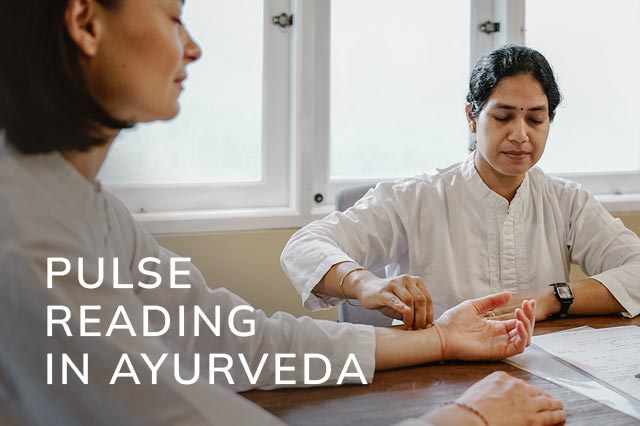
During your consultation, you may have noticed your Ayurvedic physician placing three fingers on your wrist in a specific way, holding them there quietly for several minutes while appearing to listen intently. This wasn’t simply checking your heart rate—you experienced Nadi Pariksha, one of Ayurveda’s most sophisticated diagnostic techniques that has been practiced for thousands of years.
What felt like a simple pulse check was actually your physician reading the subtle story your body tells through the rhythm, quality, and characteristics of your pulse. Through those few minutes of careful attention, they were gathering information about your constitution, current health status, and the balance of energies within your system.
The Foundation of Nadi Pariksha
Pulse reading, known as Nadi Pariksha in Sanskrit, represents one of Ayurveda’s most refined diagnostic arts. This ancient practice allows skilled practitioners to assess a person’s constitution, current health status, and potential imbalances through the subtle rhythms felt at the wrist.
In Ayurvedic medicine, the pulse is far more than a simple measurement of heart rate. It serves as a window into the body’s vital energy, revealing the state of the three doshas—Vata, Pitta, and Kapha—and their interactions within the individual. Master practitioners can detect not only current ailments but also predict future health tendencies through careful pulse analysis.
The Three Levels of Pulse Reading
Ayurvedic pulse diagnosis operates on three distinct levels:
Superficial Level (Uttana): This surface reading reflects recent influences such as diet, weather, and immediate emotional states. It provides insight into temporary imbalances and acute conditions.
Middle Level (Madhyama): The intermediate pulse reveals information about the digestive system, metabolic processes, and the current state of the seven tissues (dhatus) in the body.
Deep Level (Gambhira): The deepest pulse reading connects to constitutional patterns, chronic conditions, and the fundamental nature of the individual’s prakriti (original constitution).
Technique and Positioning
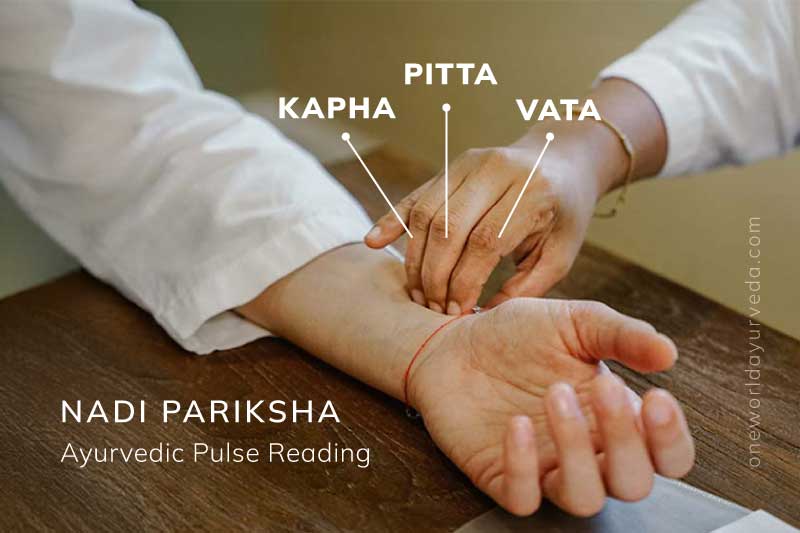
Traditional pulse reading requires precise finger placement and timing. The practitioner uses three fingers—index, middle, and ring—positioned on the radial artery of both wrists. Each finger corresponds to a specific dosha: the index finger reads Vata, the middle finger reads Pitta, and the ring finger reads Kapha.
The examination typically takes place in the early morning hours when the body’s natural rhythms are most stable. The patient should be relaxed, having avoided recent meals, exercise, or emotional stress that might alter the pulse quality.
Interpreting Pulse Qualities
Different pulse characteristics indicate various constitutional types and imbalances:
Vata Pulse: Often described as resembling a snake’s movement—irregular, thin, and quick. It may feel like it’s moving in waves or disappearing and reappearing.
Pitta Pulse: Compared to a frog’s jump—strong, bounding, and regular with a sharp, pronounced beat that seems to leap under the fingers.
Kapha Pulse: Likened to a swan’s graceful movement—slow, steady, deep, and smooth with a rolling quality that feels substantial and stable.
Modern Relevance and Limitations
While pulse reading remains a cornerstone of traditional Ayurvedic practice, it requires years of dedicated study and practice to master. The technique is highly subjective and depends greatly on the practitioner’s skill and sensitivity. Modern Ayurvedic education often combines traditional pulse reading with contemporary diagnostic methods to provide comprehensive health assessments.
Learning the Art
First formally documented in the 13th century Sharangdhar Samhita and refined over centuries, mastering Nadi Pariksha traditionally involves studying under an experienced guru for many years. Students begin by developing sensitivity in their fingertips and learning to distinguish subtle variations in pulse quality. The practice requires not only technical knowledge but also intuitive development and deep understanding of Ayurvedic principles.
Pulse reading in Ayurveda represents a profound integration of art and science, offering insights that extend far beyond conventional vital sign monitoring. When practiced skillfully, it serves as a powerful tool for understanding the intricate connections between mind, body, and spirit in the pursuit of optimal health and balance.

Related Posts