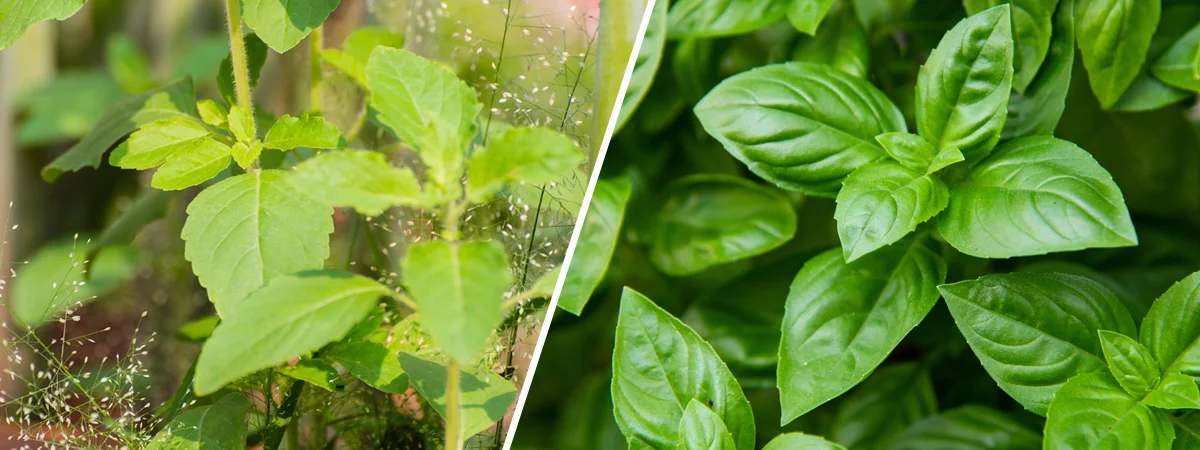
When you see a fresh green garnish on your pasta or pizza, you might assume it’s the same sacred Tulsi that has been revered in Indian households for centuries. But is that really the case?
Tulsi and basil, two incredibly medicinal and fragrant herbs that are mostly mistaken to be the same due to their botanical similarities, are actually different in their own ways. They vary in their uses, origins, and health benefits. Both the herbs Tulsi (Ocimum sanctum, also known as Ocimum tenuiflorum) and basil (Ocimum basilicum) belong to the same genus and Lamiaceae family. However, they are distinct in their traditions, usages, cultural relevance, and phytochemical compositions. As an Ayurveda practitioner, I often notice patients complaining about the confusion during selection between them.
Tulsi, “The Queen of Herbs” reflects various benefits on health. It is an auspicious herb that comes in a variety of green and purplish leaves. It can easily be seen in any Indian household due to its protective properties. Tulsi leaves have been used in various decoctions, tea preparations, and formulations for ages due to their immune-supporting properties.

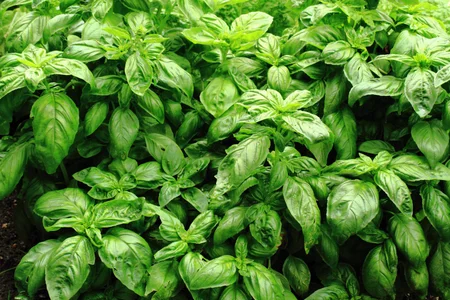
Basil is a very popular and delicious herb that shows up with beautifully shaped oval and green leaves. It is usually used in different cuisines like Italian, Thai, and Vietnamese. It has a tangy, peppery taste and a sweet aroma.
Let’s Explore How Tulsi and Basil Stand Apart
However, both tulsi and Basil belong to the same family, they still differ from each other in various aspects. From botanical names to appearance, origin, and uses, the two herbs vary distinctively. This section will assist you in understanding how they are so.
Botanical Name:
Both the herbs share the same genus, Oscimum, and the same family, Lamiaceae. Here are their botanical names:
Tulsi: Ocimum sanctum (syn. Ocimum tenuiflorum)
Basil: Ocimum basilicum
Family:
Lamiaceae family.
Native Regions:
Most of the herbs have a history for which they have been used for thousands of years, as do tulsi and basil. Now let’s see from where they originate to know more about them in detail.
Tulsi: Tulsi originates from north-central India. Tulsi is cultivated and even kept in households for its culinary and auspicious health benefits. Now it grows throughout the subcontinent of India, China, and Southeast Asia.
Basil: It is actually found in the tropical regions of Central Africa and Southeast Asia, along with the subcontinent of India. It is believed that basil originated in India but has been cultivated for around 5,000 years, with its reach worldwide.
Types and Benefits of Tulsi
Tulsi, the “holy basil,” is majorly of 4 varieties, each presented with its own different set of medicinal usages. It is categorized into four types:
- Vana Tulsi (O. gratissum): It is often used as a good adaptogen and has anti-inflammatory properties.
- Rama Tulsi (O. tenuiflorum): It possesses anti-inflammatory and antioxidant properties.
- Krishna Tulsi (O. tenuiflorum): A variety of Tulsi that presents with purple leaves. Used for immune and respiratory support
- Amrita tulsi (O. tenuiflorum): It has stress-reducing properties and provides emotional and mental support.
Types and Benefits of Basil
Basil, or Mediterranean basil, is of various types and possesses various benefits, such as:
- African Blue Basil (O. Kilimandscharicum): It is an aromatic and culinary basil with edible leaves. Contains eugenol and is used for its anti-inflammatory, anti-hyperlipidic, and antioxidant characteristics.
- American Basil (O. americanum): It is well known to possess antimicrobial and gastrointestinal support.
- Italian Genovese Basil (O. basilicum): This is truly a divine plant with a specific scent.
- Lemon Basil (O. citriodorum): It contains eugenol and flavonoids. It improves digestion, bloating, and skin issues.
- Purple Basil (O. basilicum): It is rich in polyphenol, flavonoids, and bioactive compounds. It is well known to support immunity, cardiovascular functioning, and digestion.
- Sweet basil (O. basilicum): Sweet basil contains essential oils like eucalyptol, linalool, and eugenol, which make it a potent herb to manage facial acne, migraines, and other dermal infections.
Tulsi in Ayurveda vs. Basil in the West
Tulsi: Tulsi, “the sacred plant,” is a magical herb of India. It is not just a usual herb but a rejuvenator to your skin, hair, and overall health.
In Ayurveda a herb is described well by its Raspanchak description. So, the Raspanchak of tulsi are:
- Rasa (taste) – Katu (pungent), Tikta (bitter)
- Guna (qualities) – Laghu (lightness), Rooksh (dryness), Teekshna (piercing)
- Veerya–Ushna (hot potency)
- Vipaka – Katu – Undergoes pungent taste conversion after digestion
- Effect on Tridosha—Vatahara, Kaphahara i.e., balances Vata and Kapha Dosha, and Pittavardhini i.e., increases Pitta Dosha.
Basil: Basil, on the other hand, has a separate place in Western cuisines and also provides various health benefits.
- It is known for its antioxidant properties.
- It contains eugenol, which exhibits anti-microbial, anti-inflammatory, and analgesic characteristics.
- Basil also has flavonoids, which help to facilitate anti-inflammatory and anti-cancer properties that help to fight against chronic ailments.
- Basil is considered to be a source of alkaloids that exhibit anti-parasitic and analgesic effects, making basil a culinary as well as a medicinal herb to use.
Ayurvedic Benefits of Tulsi
Looking from an Ayurvedic perspective, tulsi has immense benefits; a few of them are listed below:
- Kapha Vinashini—As per Ayurveda texts, it helps to relieve excess sputum production.
- Krumidosha, Krumihara—It refers to the antimicrobial and antiviral properties that help to fight against any foreign body.
- Ruchikrut—It means it develops interest in food; this property helps to manage anorexia.
- Agnivardhini, Vahni Deepani—This characteristic helps to improve the digestive fire and facilitate better digestion.
- Hrudya—It functions as a cardiac elixir and aids in managing unwanted cholesterol deposition in the blood.
- Dahavardhini—Since it is Pittavardhaka in nature, it increases the burning sensation.
- Shwasahara—It helps in curing respiratory illness.
- Kasahara—Useful in the treatment of cough, flu, and cold.
Modern View of Tulsi Health Benefits
Immunity and Respiratory Health
This mother of herbs enhances the immunity by providing more resilience to infections. The incredible antimicrobial and antiviral effect enables it to fight against any invader inside the body.
Stress and Adaptogenic Support
It is a known adaptogen that aids in balancing cortisol (the stress hormone) levels and promotes emotional stability.
Benefits of Tulsi for Skin
When it comes to skin, tulsi works wonders.
- It contains antioxidants that help to prevent skin from radical damage and also from harmful effects of UV rays.
- This herb is packed with the goodness of anti-bacterial properties that help to resist the growth of acne-causing bacteria.
- It is also rich in vitamin C and eucalyptol that help the skin to look more radiant, flawless, and young.
Tulsi Benefits for Hair
This queen not only is restricted to your internal health but also enhances your outer appearance; it shows its effects on:
- Hair thinning: Tulsi is used for preventing hair loss due to its anti-inflammatory traits that can stimulate the scalp and promote hair growth.
- Dandruff: It aids in removing dandruff due to its anti-fungal properties.
Benefits of Basil
There are numerous benefits that basil offers; here is a list:
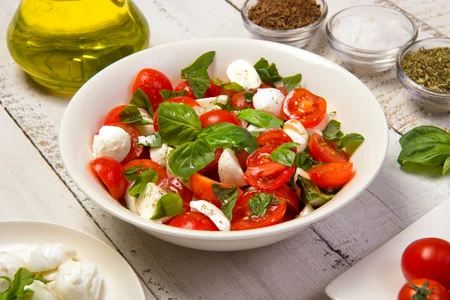
- Culinary Use and Nutritional Profile – Basil is well known for its importance in Caprese salads. However, apart from its flavor, it also offers various health benefits. It contains vitamins A, C, and K, iron, calcium, and magnesium. Also, it contains constituents like eugenol and linalool that present with anti-inflammatory and antimicrobial properties.
- Antioxidant and Antimicrobial Properties—The green, oval leaves of basil have flavonoids like vicenin that prevent the cell from any oxidative stress.
- Digestive Support—It is also infused with herbal preparations to pacify bloating, cramps, and indigestion.
Can Tulsi and Basil Be Used Interchangeably?
This is actually one of the most frequently asked questions in my OPD. The answer to this is simply no; at least therapeutically, you cannot. The reasons are clearly evident from the above information.
Common Myths
- Tulsi is just a household plant: No, it is a medicinal as well as a sacred plant with numerous health benefits.
- Tulsi and basil are the same: Absolutely not, they just belong to the same genus and family but possess different properties.
- Basil is just used in salads: Clearly not. It has many therapeutic uses as well.
What’s Lost or Gained When Substituted
Well, substituting both is not a good idea, but:
If you substitute tulsi for basil in recipes, it will give a clove-like flavor and may alter the taste.
If you substitute basil for tulsi in formulations, it will indeed alleviate the efficacy and efficiency of the formulation.
My Clinical Experience
In my Ayurvedic practice, I’ve witnessed many patients where tulsi and its formulations have shown really good effects; some of them are:
- A 35-year-old woman presented with acne. Her history revealed a stress-induced hormonal imbalance, which could be a probable cause of acne.
- I advised her to incorporate Tulsi tea twice a day in her routine and asked for a follow-up after 30 days. Incredibly, her acne ceased, she had no new acne growth, reduced skin inflammation, and better sleep cycle.
- A 27-year-old male came with complaints of pain in the throat and cough for 10 days. I suggested him to takeTulsi swaras for 07-10 days and then come for follow-up. After 08 days his pain was gone, his cough was also under control, and he was feeling much better.
- NOTE: Do not use any medications without the prescription of your healthcare provider. Since, the dosage, anupana, and mode of administration vary from patient to patient.
Conclusion
Tulsi and basil both may appear similar botanically but have totally distinctive properties. Tulsi stands as a sacred, rejuvenator, or rasayana herb, while basil is a tongue pleaser and is garnished in various cuisines, elevates taste, and offers digestive and antioxidant benefits.
Understanding their differences may help you understand their uses and take advantage of their benefits wisely. It is not only important to treat your patients but also to unlock the key to various health benefits to maintain a longer, better, healthier, and happier life.

Related Posts